
FACT CHECKED
An overbite wearing down your lower front teeth. An underbite that makes biting into food awkward. A crossbite that pulls your jaw sideways when you chew. If one sounds like yours, you want to know exactly how aligners would fix it.
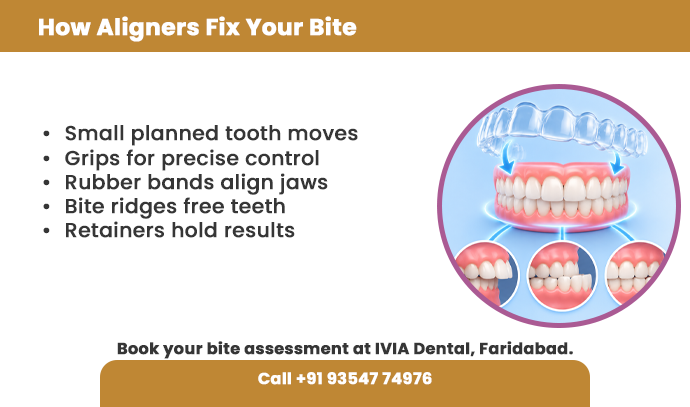
Each bite needs a different movement. For an overbite, aligners push the upper front teeth back while bite ramps let the back teeth rise. For an underbite, they tip the lower front teeth back, often helped by rubber bands. For a crossbite, they widen the upper arch or tip trapped teeth outward. This works when the problem comes from tooth position, not the jaw.
At IVIA Dental, Metro Heart Institute, Faridabad, aligner cases are planned by an experienced orthodontist.
Below, each bite is broken down, with how to check yours qualifies and the steps that follow.
How Do Clear Aligners Correct an Overbite?
Aligners correct an overbite by moving the upper front teeth slightly back and up and letting the back teeth rise, so the front teeth stop overlapping so deeply.
Each new set shifts your teeth a fraction of a millimetre, and over months that changes how they meet. For an overbite, the plan usually adds a few helpers:
- Bite ramps are small ridges inside the aligner, behind the upper front teeth. Your lower teeth touch these first, which keeps the back teeth slightly apart so they can rise into a better position.
- Attachments are tooth-coloured bumps bonded to a few teeth. They give the aligner something to grip, so it can push teeth in directions plastic alone can’t.
- Elastics are small rubber bands hooked between the upper and lower aligners. For an overbite, they gently pull the lower teeth forward to meet the upper ones.
You won’t need all three. Your plan uses only what’s needed.
How Do Clear Aligners Correct an Underbite?
Aligners correct a tooth-based underbite by tipping the lower front teeth back and the upper front teeth forward, until the upper teeth close in front again.
The lower teeth often need space before they can move back. That’s created by shifting the back teeth slightly, or by smoothing a very thin layer between some teeth.
- Elastics run the opposite way to an overbite. They pull from the lower front of your mouth towards the upper back teeth.
- Attachments on the front teeth help tip them the right way.
This works only when the underbite comes from tooth position. If your lower jaw itself sits too far forward, aligners can’t move the bone.
How Do Clear Aligners Correct a Crossbite?
Aligners correct a crossbite by widening the upper arch or tipping the trapped teeth outward, until they sit outside the lower teeth as they should.
A front crossbite usually involves one or two upper teeth stuck behind the lower ones. The aligner’s thin layer of plastic separates your teeth slightly, which gives the trapped tooth room to move forward past the lower tooth.
A back crossbite usually means your upper arch is a little narrow. Aligners widen it by tipping the upper back teeth outward, with attachments for grip. In adults, a very narrow upper jaw may need an expander first, since aligners can’t widen bone.
When we plan clear aligners in Faridabad, crossbites get extra care, because uneven chewing wears one side of the mouth faster.
| Bite Problem | What the Aligner Plan Uses |
|---|---|
| Overbite | Bite ramps, attachments, sometimes elastics |
| Underbite | Elastics, space creation, attachments on front teeth |
| Front crossbite | The aligner’s thickness to free the tooth, plus attachments |
| Back crossbite | Arch widening with attachments, sometimes an expander first |
How Do You Know If Aligners Can Correct Your Bite?
A 3D scan and a side-view jaw X-ray show whether your bite comes from tooth position, which aligners can fix, or from your jaw, which they can’t fix alone.
In a tooth-based bite, your jaws are fine but some teeth are tilted, crowded or out of place. In a jaw-based bite, the jaws themselves don’t match in size or position. Signs that point to the jaw:
- a lower jaw that looks clearly forward from the side
- the same bite pattern in a parent or sibling
The X-ray that settles it is a cephalometric X-ray, a side picture of your head that shows how your jaws line up. Orthodontists group bites into classes. Class II means the upper teeth sit too far forward of the lower teeth. Class III means the lower jaw sits forward. A true Class III pattern is uncommon: an Indian meta-analysis published in the International Journal of Adolescent Medicine and Health found it in 2.2% of children and adolescents.
A routine check-up with a dentist near me may not include this X-ray. If you’re considering aligners for your bite, ask for it.
Will Aligners Fix Your Bite, or Will You Need Braces or Jaw Surgery?
For mild to moderate bites caused by tooth position, aligners are usually enough. Adults whose bite comes from the jaw usually need braces combined with jaw surgery.
Here’s how it usually splits:
- Aligners are usually enough when the jaws line up and the bite comes from tilted or crowded teeth.
- Braces may work better when teeth are badly rotated or need to move a long way, because fixed brackets give more control.
- Jaw surgery is usually needed when an adult’s jaws are mismatched in size or position.
Age changes the answer. A child’s jaw is still growing, so a jaw problem caught early can often be guided with simpler appliances. That’s why it’s worth showing a child’s crossbite or underbite to a children’s dentist early.
You should hear which group you’re in at your first visit, before you pay anything. Not halfway through.
What Are the Next Steps to Correct Your Bite With Clear Aligners?
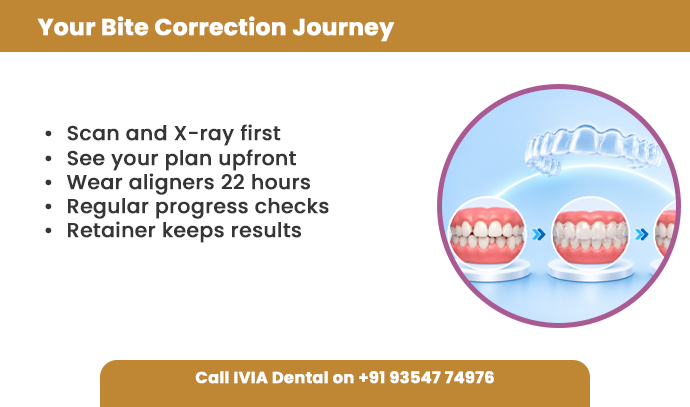
Bite correction with aligners runs in six steps, from an assessment to a retainer that holds the result.
- Start with a bite assessment. If you’ve been searching for a dental clinic near me because of your bite, ask specifically for a bite assessment, not just a cleaning. It’s a 3D scan, an X-ray and a check of how your teeth meet.
- Review your digital plan. You’ll see the predicted tooth movement and the number of aligners before you agree to anything, along with your expected treatment time.
- Get your attachments and first aligners. The grips are bonded in one short visit, and you’ll take home your first sets.
- Wear them daily. Aligners only work while they’re in, so plan on about 22 hours a day. You’ll switch sets on your orthodontist’s schedule and add elastics if your plan uses them. Our guide to common aligner mistakes covers what slows progress.
- Keep your progress checks. Visits confirm your teeth are on track. If some lag behind, extra refinement aligners finish the job.
- Switch to a retainer. Teeth drift back once treatment ends. A retainer, worn as advised, holds your new bite.
Book Your Clear Aligner Consultation in Faridabad at IVIA Dental
Start by finding out what kind of bite you have. Aligners correct tooth-based overbites, underbites and crossbites well. Jaw-based bites don’t respond to aligners alone, and an assessment tells you which you’ve got before you commit.
A consultation for clear aligners in Faridabad at IVIA Dental covers:
- a 3D scan and a check of how your teeth meet
- an X-ray to see whether your jaws are involved
- a preview of your aligner plan and expected timeline
- the full cost before anything starts [PENDING CONFIRMATION]
Your plan is prepared by an experienced orthodontist. Call +91 93501 30755 or +91 93547 74976, or book an appointment. Our complete guide to Invisalign is worth a read before your visit.
Frequently Asked Questions
Can Clear Aligners Fix a Severe Overbite?
If it’s tooth-based, often yes, with bite ramps and elastics. If the upper jaw sits far ahead of the lower one, aligners alone usually can’t fix it.
Can Adults Fix an Underbite Without Surgery?
Yes, if the underbite is tooth-based. If the lower jaw itself is too far forward, adults usually need orthodontic treatment combined with jaw surgery.
Are Clear Aligners or Braces Better for a Crossbite?
Aligners suit front crossbites and mild back crossbites. A very narrow upper jaw or badly rotated teeth may need braces or an expander.
Do You Have to Wear Rubber Bands With Aligners?
Only if your plan needs them. Overbite and underbite plans often use them; crossbite plans often don’t.
At What Age Should a Child’s Crossbite Be Treated?
Early, while the jaw is still growing. Many children get a first bite check around age 7.
Will My Bite Move Back After Aligner Treatment?
It can, if you stop wearing your retainer. Wear it as advised and your result stays.