
FACT CHECKED
You’ve been told you need a dental implant, or you’ve just had one. Now you’re wondering if your face will swell before Monday’s meeting, and whether the implant could still fail after all that money.
Here’s the short answer. Most dental implant side effects are mild and temporary: swelling, soreness, light bruising and a little bleeding, which usually settle within a week. Infection, implant failure and nerve injury are complications. They’re uncommon, and careful planning before surgery prevents most of them.
We’re the implant team at IVIA Dental, Metro Heart Institute, Sector 16A, Faridabad. Our implant care is led by a periodontist, a gum and bone specialist trained in implant surgery, with over 18 years of clinical practice.
Read on this guide on Dental Implant Surgery: Side Effects, Recovery, and Tips for a day by day recovery details and the exact signs that mean you should call us.
Which Side Effects Should You Expect, and Why Do They Happen?
- Swelling of the gum and cheek, from that extra fluid.
- A dull ache once the numbness wears off. Prescribed painkillers usually control it.
- Light bruising on the cheek or jaw, more likely if you take blood thinners.
- Pink saliva or slight oozing on the first day.
- A stiff jaw, because your mouth was held open during the procedure.
Do Side Effects Last Longer After a Bone Graft or Sinus Lift?
Usually by a few days. A bone graft adds bone where your jaw is too thin for an implant. A sinus lift makes room above the upper back teeth. Both handle more tissue, so swelling lasts longer.
How Long Does Dental Implant Recovery Take, Day by Day?
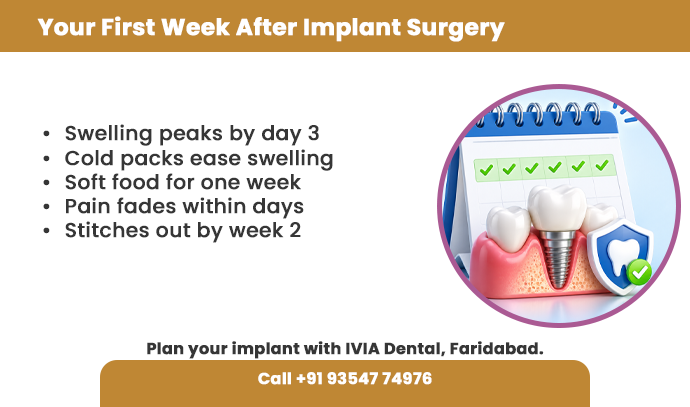
Most people feel close to normal within a week. The bone then takes 3 to 6 months to bond with the implant, called osseointegration. Several implants or a graft can slow things down. Our guide to the phases of the implant procedure covers each stage.
| Time | What’s Normal |
|---|---|
| Day 1 | Numbness fades in a few hours. Expect an ache and some oozing. |
| Days 2 to 3 | Swelling is at its biggest. Cold packs and soft food help most now. |
| Days 4 to 7 | Pain and swelling ease a little each day. |
| Weeks 2 to 4 | Stitches are out and the gum looks healed. Keep chewing on the other side. |
| Months 3 to 6 | The bone bonds with the implant. You won’t feel it. The crown goes on after this. |
What Is the Difference Between a Dental Implant Side Effect and a Complication?
A side effect is expected and fades on its own. A complication needs treatment from your dentist.
These are the dental implant surgery side effects that cross that line:
- Infection: pain, pus or a bad taste that gets worse after day 3.
- Early failure: the bone doesn’t bond, and the implant stays loose.
- Nerve irritation in the lower jaw, felt as numbness or tingling in the lip or chin.
- Sinus trouble after an upper jaw implant, with congestion that won’t clear.
- Peri-implantitis: an infection, months or years later, that destroys the bone holding the implant.
Can an implant get infected? Yes. Titanium can’t decay like a tooth, but the gum and bone around it can.
A 2024 Cureus study from Indian dental colleges found early failures appeared at around 6 months and late ones at around 17 months, mostly from smoking and peri-implantitis. Care doesn’t stop when the crown goes on.
Which Warning Signs Mean You Should Call Your Dentist Straight Away?
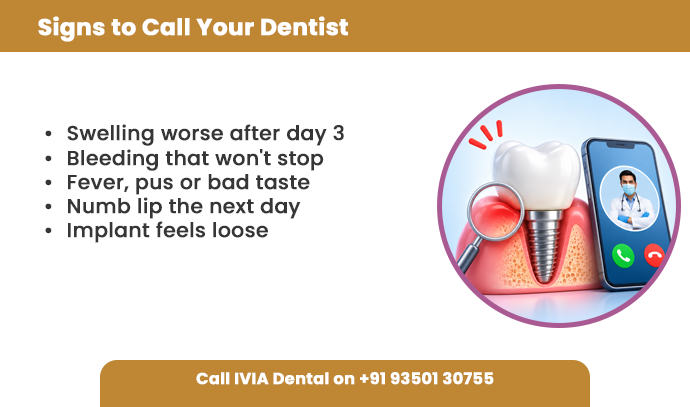
Call your dentist if symptoms get worse after day 3 instead of better. Call the same day for:
- Swelling or pain that’s increasing after day 3
- Bleeding that doesn’t slow after 30 minutes of firm pressure on gauze
- Fever, pus, or a foul taste from the site
- Numbness in your lip, chin or tongue the day after surgery
- An implant that feels loose
Had your implant placed elsewhere and can’t reach your surgeon? Find a dental clinic near me in Faridabad and get it checked within a day.
Can a Dental Implant Fail or Damage a Nerve, and How Likely Is It?
Failure is uncommon in healthy patients, and most of the risk can be found and managed before surgery.
A 10 year Indian review of 826 patients and 1,420 implants, published in the Journal of Family Medicine and Primary Care in 2020, found healthy patients had the lowest failure rate, at 4.37%. Failures were most common in:
- smokers
- people with high blood pressure
- people with diabetes
- people with heart disease
Nerve injury is mostly a planning problem. The nerve that gives feeling to your lower lip runs inside the lower jaw. A CBCT scan, a 3D X-ray of your jaw, protects it in two ways:
- it shows exactly where the nerve sits
- it lets us choose an implant length and angle that stays clear of it
We won’t tell you the risk is zero. We’ll find your personal risk factors before we fix a date.
Who Has a Higher Risk of Implant Complications?
Smokers, people with uncontrolled diabetes and people with untreated gum disease carry the highest risk.
ICMR’s INDIAB study found 12.4% of adults in Haryana have diabetes, above the national 11.4%, rising to 17.9% in urban areas. A sugar test before surgery is worth it even if you feel fine.
| Risk Factor | What to Do Before Surgery |
|---|---|
| Smoking | Stop before surgery and stay off it while the bone heals. |
| Diabetes | Get your HbA1c, your 3 month average sugar, under control first. |
| Heart disease or blood pressure | Bring your full medicine list. We may speak to your physician. |
| Blood thinners | Never stop them yourself. Only your doctor should change the dose. |
| Gum disease | Treat it first. The same bacteria can attack the implant. |
| Teeth grinding (bruxism) | Ask about a night guard to protect the implant. |
How Can Implant Complications Be Prevented?
Prevention starts with planning before surgery and continues at home.
What Should Your Dentist Do Before Surgery?
Whichever dentist in Faridabad you choose, expect these before a date is fixed:
- A CBCT scan to measure your bone and map nerves and sinuses.
- Treatment of any gum disease.
- A full medical history, including every medicine you take.
- Sugar and blood pressure checks where needed.
If a clinic offers to place an implant without a scan, ask why.
What Are the Best Recovery Tips After Implant Surgery?
- Hold a cold pack on your cheek, 15 minutes on and 15 off, through the first day.
- Eat soft, lukewarm food like dal, khichdi, curd and idli for the first few days.
- Don’t smoke, use straws or spit hard for 3 days. Suction can dislodge the healing clot.
- Start gentle salt water rinses from the next day, or when your dentist says.
- Take every medicine as prescribed, including the full antibiotic course.
- Sleep with your head on an extra pillow for two nights.
- Keep your review visit.
How Do You Keep an Implant Healthy for Years?
Brush and floss around it like a natural tooth. The early warning stage is peri-implant mucositis, gum swelling and bleeding around the implant before any bone is lost. Caught then, a professional cleaning can reverse it. Our guide to swollen gums explains what that bleeding means.
Book Your Dental Implant Surgery or Consultation in Faridabad at IVIA Dental
Get your risk checked first. Side effects are short, and most complications are prevented by what’s found before surgery. Smooth dental implant recovery starts at that first visit.
Every implant at IVIA starts with a planning visit. Our dental implants in Faridabad are planned by specialists:
- Dr. Komal Meena, Head of Department, holds an MDS in Periodontics and Oral Implantology from PGIDS Rohtak, so gum problems are treated first, often with laser gum treatment.
- Dr. Shruti Khatana, an oral and maxillofacial surgeon, handles complex surgical cases.
Your consultation covers a CBCT review of your bone, a gum check, and your sugar, blood pressure and medicines. We show you what your scan found, and you’ll know the full cost before anything starts.
If you’re looking for a dental clinic near me Faridabad, call +91 93501 30755 or book an appointment.
Frequently Asked Questions
How Long Does Swelling Last After a Dental Implant?
It peaks on day 2 or 3 and fades within a week, or up to 10 days after a graft. Swelling that grows after day 3 needs a check.
Is It Normal to Still Have Pain a Week After Implant Surgery?
Mild tenderness when chewing can last a week. Pain that’s getting stronger isn’t one of the usual dental implant surgery side effects and should be checked.
Can I Go to Work the Day After Dental Implant Surgery?
Most people with a desk job go back the next day after a single implant. After several implants or a graft, plan 2 to 3 days off.
What Can I Eat After Dental Implant Surgery?
Soft, lukewarm food like dal, khichdi and curd for the first week. Skip spicy, crunchy and sticky food.
Can I Get Dental Implants If I Have Diabetes?
Yes, if it’s well controlled. High sugar slows healing and raises infection risk, so your dentist should check your HbA1c first.
What Are the Signs of a Failing Dental Implant?
Looseness, pain or swelling after healing, pus, or gum shrinking back to show metal.