
FACT CHECKED
If you are searching for steps of Dental Implant Treatment, the process is divided into three clear phases:
- Planning phase with evaluation and scans,
- Surgical phase where the implant is placed into the bone, and
- Final restoration phase where the new tooth is fixed and adjusted for bite and comfort.
At IVIA Dental Clinic in Faridabad, located inside Metro Heart Institute with Multispeciality in sector 16A, these 3 stages of dental implant are handled only by specialist dentists trained at institutes like MAMC, AIIMS and PGIDS. We use digital imaging, guided implant planning, medical-grade sterilisation, and a hospital-supported setup that allows safer care for patients with diabetes, BP or other conditions.
For patients looking for dental implants in Faridabad or searching online for teeth implants near me, our structured, technology-supported dental implant treatment approach provides a clear path from a missing tooth to a strong, long-lasting and natural-looking replacement.
Book your appointment with our expert dentists in Faridabad now at +91 9350130755.
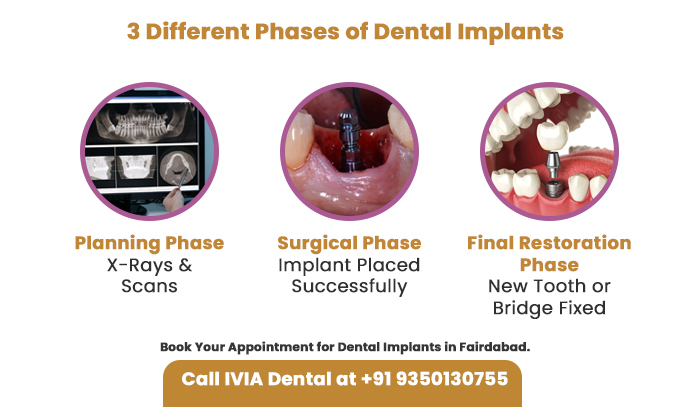
Phases of Dental Implant Procedure Explained by Expert Dentists at IVIA Dental
Anyone looking for teeth implants near me needs a simple breakdown of the steps of dental implant treatment. The three phases below explain each stage clearly so you understand how the implant is planned, placed and restored.
Dental ImplantStage 1: Planning Phase – Evaluation, Scans and Treatment Strategy
In the first dental implant treatment stage, our dentists checks whether implants are ideal for you and how they should be placed.
Key steps include:
- Complete evaluation of teeth, gums, and general oral health.
- Detailed oral assessment of missing teeth, chewing pattern, and bite balance.
- A 3D CBCT Scan to measure jaw shape, nerve position, and bone density.
- Review of medical issues such as diabetes, hypertension, or osteoporosis.
- Identification of risk factors like smoking or night grinding in bruxist patients.
This first stage of dental implants help dentists understand if the jawbone is strong enough for an implant or if it needs support.
Based on this, the specialist creates a treatment strategy that may involve:
- A bone graft where the jawbone is thin or has bone resorption.
- Ridge augmentation if the ridge needs more width or height.
- A sinus lift for upper back teeth when there is limited bone under the sinus.
- Soft tissue augmentation if the gingiva is thin around the planned implant.
Modern tools improve accuracy in this phase:
- Digital impression and intraoral scanner to capture your teeth and gums.
- Guided surgery planned on software.
- A customised surgical guide that shows exact angle and depth during implant placement.
Dental Implant Stage 2: Surgical Phase – Implant Placement and Early Healing
The second stage is when the implant is placed into the bone under local anaesthesia in a sterile setting.
The steps in second phase of dental implants include:
- Careful flap design in the gum to expose the bone.
- Implant bed preparation using measured drills.
- Placement of a titanium implant to achieve primary stability.
- Use of a torque wrench to confirm the planned values.
In most patients, the implant is placed directly in the bone. In rare situations, a subperiosteal implant is chosen when the bone cannot support a regular design.
After placement, the specialist decides between two approaches:
- Submerged implant with a cover screw, hidden under the gum.
- Non-submerged implant with a visible healing screw or gingival former to shape the gum.
For selected patients with strong bone and good stability, faster options may be offered:
- Immediate implant on the same day as tooth removal.
- Immediate loading with a temporary tooth soon after surgery.
- Full arch Teeth in a Day protocols.
- All-on-4 concepts for complete jaw replacement.
Dental implant options depend on bone strength, gum condition, and bite balance. Not every implant type is suitable for every patient. They are explained clearly by our experts during planning.
Dental Implant Stage 3: Final Restoration Phase – Crown Placement and Bite Correction
The final restoration phase of dental implants, which is the 3rd stage, often begins with the healing phase. During this time:
- The bone forms around the implant, creating secondary stability.
- The team checks peri-implant health at reviews.
- Early warning signs like mucositis, bleeding index changes, or increased probing depth are monitored.
- The goal is to avoid infection and peri-implantitis and to preserve bone, reducing crestal bone loss.
Once healing is done, the visible part of your new tooth is created. Steps include:
- Fitting an abutment on the implant, either a stock abutment or custom abutment.
- Recording the mouth with an impression coping and implant analog, or using a scan body with a digital workflow.
- Mounting models on an articulator to simulate chewing and refine your occlusion.
Your final prosthesis may be:
- A single zirconia crown or porcelain fused metal crown.
- A hybrid prosthesis supported by several implants.
- An implant supported bridge or fixed partial denture.
- A removable overdenture or removable partial denture clipped to implants.
The crown or bridge may be cement retained or screw retained, depending on cleaning access and future maintenance. Design features like platform switching help reduce the microgap at the implant–abutment junction and protect the bone.
After crown placement, bite contacts are fine-tuned so chewing loads are shared safely and do not overload any implant, particularly in full arch or implant supported bridge cases.
These 3 stages of dental implant planning decides whether you are suitable for a single dental implant, multiple implants, a full arch solution, All-on-4, an overdenture, or other designs seen in advanced dental implants in Faridabad cases.
Book Your Dental Implants Appointment in Faridabad at IVIA Dental Now
When you visit IVIA Dental, we first listen to your concerns, review your reports and check whether a single implant, multiple implants or a full-arch solution suits you best. You get clarity on timelines, comfort, maintenance and budget before you commit to treatment along with:
- Implant care under trained specialists who are alumni of MAMC, AIIMS and PGIDS, bringing years of focused training in advanced dentistry and implants.
- Digital tools like CBCT 3D scans and guided planning are used for implant cases, helping decide ideal position, angle and depth before surgery and improving precision.
- A sterile surgical environment inside Metro Hospital Faridabad.
- Transparent guidance on timelines, healing, and expected results.
- Clear follow-up plans to protect long-term survival rate.
Call IVIA Dental Clinic on +91 9350130755 to book your dental implants appointment in Faridabad now.
FAQs
1. How long does dental implant treatment take from start to finish?
Most patients complete planning, surgery and final restoration in 3-6 months, depending on bone support and healing. Complex cases or grafting may require more time.
2. Is dental implant surgery painful or uncomfortable?
No. At IVIA Dental in Faridabad, the area is fully numbed. Patients usually feel pressure, not pain, and mild post-surgery soreness settles within a few days.
3. How soon after extraction can I get a dental implant?
If bone is healthy, an implant may be placed immediately. Otherwise, dentists wait 8–12 weeks for initial healing before placement, depending on your case.
4. Can dental implants be done in one day (same-day implants)?
Same-day implants are possible only when bone is strong and implant stability is high. Our Faridabad specialists confirm suitability after scans and clinical evaluation.
5. Are dental implants suitable for everyone?
Most adults qualify, but bone strength, gum health and medical conditions like diabetes are evaluated first. IVIA Dental checks suitability through scans and a detailed assessment.