
FACT CHECKED

Something is not right with your routine. You brush every day. Still, your last check-up found a cavity. Or your gums bled when the dentist probed them. Or the sensitivity when you drink cold water has been there for months.
The problem is usually not how often you brush. It’s what the routine is missing. The angle of the brush or the surface floss reaches which bristles cannot.
Oral hygiene: best practices & instructions for good routine by Dr. Komal Meena and the team at IVIA Dental, Faridabad alumni of MAMC, AIIMS, and PGIDS close those gaps. We work with patients who are already brushing but still running into problems. And here is the guide, how?
What Does a Good Daily Oral Hygiene Routine Look Like?
Every good daily routine includes brushing with the right technique, cleaning between teeth, the tongue, and right timing for each step. Most people do some of these. Very few do all of them and the ones people skip are usually the ones that matter most.
-
Brushing Technique Matters More Than Time
Two minutes twice a day is the standard advice. What most people don’t know is that the angle and motion matter as much as the duration.
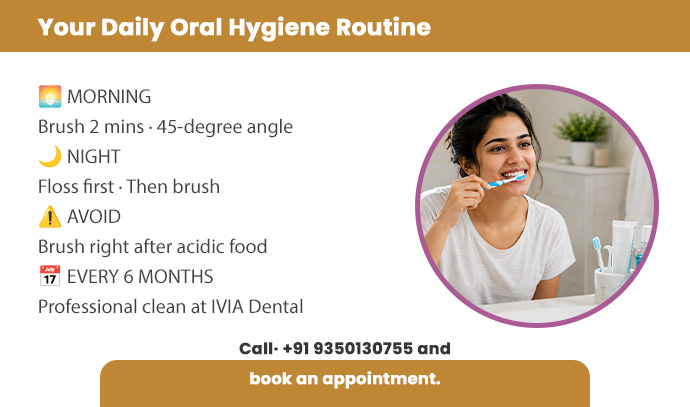
- Hold the brush at a 45-degree angle to the gum line.
- Use short circular movements rather than scrubbing back and forth.
- Brush all five surfaces of each tooth : the outer face, the inner face, and the chewing surface.
- After brushing, spit but don’t rinse. Rinsing immediately washes the fluoride off before it can strengthen enamel.
-
Flossing The Surfaces Brushing Cannot Reach
Brushing cleans three of the five surfaces of each tooth. The two surfaces pressed against neighbouring teeth only get cleaned with floss. These are where cavities most commonly start, and where gum disease begins. Floss once a day at night before brushing, not after. Flossing first removes the debris that brushing then sweeps away.
Water flossers are a good alternative for people who find traditional floss difficult to use, or for anyone with braces, implants.
-
Tongue Cleaning
The tongue holds more bacteria than anywhere else in the mouth. Most cases of bad breath that persist despite brushing come from bacteria on the back of the tongue, not from the teeth themselves. A tongue scraper used once daily removes this buildup in under 30 seconds.
-
Mouthwash
Mouthwash reaches areas brushing and flossing miss. It’s useful as an add-on, not a replacement. Antiseptic mouthwash is specifically useful for patients managing gum disease between professional treatments by the best dentist in Faridabad.
What Can a Dentist Do That a Home Routine Cannot?
Two things no home routine can do: remove tartar and catch problems before they become symptoms. Brushing and flossing remove plaque, the soft, sticky film that forms on teeth daily. When plaque is not removed consistently, it hardens into tartar, a calcified deposit that no toothbrush or home product can touch. Only professional scaling by a dentist in Faridabad removes it.
Large-scale dental screenings in India have found that 9 in 10 people have some form of dental problem and only 1 in 10 visits a dentist regularly. That gap is where tartar builds, gum disease progresses, and early decay reaches the nerve all without the patient feeling anything until it is too late to fix.
A check-up by the best dentist in Faridabad every 6 months checks:
- Early decay before it reaches the nerve, when it can be treated with a simple filling rather than a root canal
- Early gum disease, when it’s still reversible
- Changes in soft tissue, early oral cancer screening, which is particularly relevant for patients who use tobacco or betel nut
- Old restorations that are cracking or leaking before they fail completely
Hence, the appointment most people skip is the one that keeps the others simple.
Lifestyle Choices That Protect or Damage Your Teeth
What happens outside the bathroom matters as much as what happens during brushing. Some habits damage teeth slowly and silently. Others protect them just as effectively as a good routine.
Tobacco and Betel Nut
Smoking causes gum disease by reducing blood flow to the gum tissue, which impairs the body’s ability to fight infection and heal. Patients who smoke are up to three times more likely to develop gum disease than non-smokers. Chewing tobacco and betel nut cause direct tissue damage, significantly increase oral cancer risk, and stain teeth.
Sugar
Every time sugar enters the mouth, bacteria produce acid that attacks enamel for around 20 minutes. Three sweets in one sitting produce one acid attack. The same three sweets eaten one at a time across an afternoon produce three separate acid attacks. Snacking frequency is a more significant factor in cavity development than total sugar intake.
Staying Hydrated
Saliva is the mouth’s natural defence against acid and bacteria. When the mouth is dry from dehydration, mouth breathing, or certain medications bacteria multiply faster and acid damage is more sustained. Drinking water throughout the day helps maintain the protective saliva environment.
Brushing Timing
Brushing immediately after eating acidic food or drinking citrus juice softens enamel by acid, then removes it with the toothbrush. Wait 30 minutes after acidic food or drink before brushing. Rinse with water immediately if you want to remove the acid faster.
A dental clinic near me Faridabad consultation at IVIA Dental covers both the daily routine and the lifestyle factors specific to your oral health situation. Dr. Komal Meena and the team review existing habits, identify where problems are coming from, and give specific guidance.
Book Your Check-Up at IVIA Dental, Faridabad.
If your daily routine is already in place and you’re still experiencing sensitivity, bleeding, or recurring problems, the answer is usually found at a professional assessment.
IVIA Dental team of MAMC, AIIMS, and PGIDS alumni provides preventive care, professional scaling, gum treatment, and full restorative dentistry at the same clinic in Faridabad. Call: +91 9350130755 and book a consultation.
Frequently Asked Questions
How Long Should I Brush My Teeth?
Two minutes, twice a day. The real issue is most people brush for under 45 seconds and think that’s enough. A built-in timer on an electric brush solves this.
Is Mouthwash Necessary if I Already Brush and Floss?
It’s an add-on, not a requirement. Where it earns its place is reaching spots the brush and floss both miss and timing it separately from brushing matters.
What Causes Bad Breath Even After Brushing?
The tongue. Bacteria on the back of the tongue cause most persistent bad breath, not the teeth. A tongue scraper handles this faster than any mouthwash will.
How Often Should I Replace My Toothbrush?
Three months is the standard. Splayed bristles are the visible sign it’s overdue, they clean less effectively than they look. Replace immediately after any illness.