
FACT CHECKED
It’s been two years since your last dental visit. Nothing hurts, so the check-up keeps moving to next month. Sound familiar?
So how often should you visit the dentist? Every six months is a good default for most adults. But the right gap for you can be anywhere from 3 to 24 months.
It depends on two things: the health of your gums, and how often you get cavities. The good news is that you can work out your own gap in a few minutes.
We’re IVIA Dental, the dental department at Metro Heart Institute, Faridabad. Our team is led by Dr. Komal Meena, a periodontist (gum specialist). She has over 18 years of clinical and teaching experience. Below, we explain How Often Should You Visit the Dentist? Expert Advice, how to find your gap and what a fair check-up should include.
How Often Should You Visit the Dentist?
Most adults should see a dentist every six months. Think of it as a starting point. Based on your risk, the right gap can be as short as 3 months or as long as 24.
We call this gap your recall interval. We review it at every visit, and we’ll always tell you why it changed.
Does the Six-Month Rule Really Hold Up?
Partly. Six months suits many people. But research shows that a gap based on your own risk works just as well. Here’s what the evidence says:
- The UK’s health guideline body, NICE, tells dentists to set adult check-ups anywhere from 3 to 24 months. For under-18s, the gap should be 12 months at most.
- A large UK trial ran for four years. Adults on a risk-based gap had the same oral health as those seen every six months.
- In the same trial, low-risk adults did just as well on a 24-month gap.
There’s a catch, though. Everyone in that trial had seen a dentist in the past two years.
If it’s been longer for you, start with one full check-up. Then we can tell you which group you fit.
Which Check-Up Gap Is Right for You?
Your gap depends on how fast problems build up in your mouth. Here’s what we look at.
- Healthy Gums and No New Cavities – If your gums don’t bleed and your last few visits found nothing new, you’re likely low risk. We can stretch your gap slowly, as long as things stay stable.
- Gum Disease, Diabetes or Tobacco Use – Gum disease can quietly eat away the bone that holds your teeth. Diabetes and gum disease also make each other worse. Tobacco is tricky. It stops gums from bleeding, so they look healthier than they are. Tell us if you smoke or chew tobacco, so we can check more closely.
- Cavities That Keep Coming Back – Repeat cavities mean the cause is still there. Often, it’s frequent snacking or a dry mouth. Short gaps help us catch new spots while they’re small.
- Children and Teenagers – Decay spreads faster in children, and faster still in milk teeth. That’s why a child’s gap should never go past a year.
- Pregnancy – Pregnancy hormones make gums swell and bleed more easily. Book a visit early and tell us you’re expecting. We’ll plan any X-rays or treatment around it.
- Older Adults, Dentures and Implants – Many common medicines cause a dry mouth, which raises the risk of decay. Implants need regular checks too. Gum infection around an implant can loosen it.
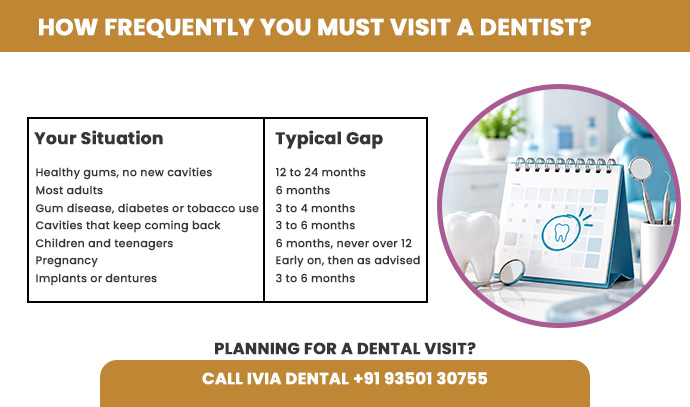
Use these as starting points. We set your final gap after we examine you.
If Nothing Hurts, Do You Really Need a Dental Check-Up?
Yes. The two most common dental problems don’t hurt until they’re advanced.
- Early decay sits in the enamel, the hard outer layer of the tooth. It has no nerves, so you feel nothing.
- By the time it aches, decay is often near the nerve. A small filling can then turn into a root canal.
- Gum disease is even quieter. Bleeding when you brush may be its only early sign.
Many people in India wait for pain. In one study at an urban Indian dental hospital, 45% of patients hadn’t seen a dentist in over two years. Pain was the most common reason they came in.
The problem is huge. WHO’s 2022 oral health report put India’s oral disease cases at about 632 million in 2019. That’s the highest of any country.
What Happens During a Routine Dental Check-Up?
Most of a proper check-up is careful looking. Here’s what we do, step by step:
- We ask about your medicines, your health and any changes you’ve noticed.
- We check each tooth for decay, cracks or worn fillings.
- We measure your gum pockets, the small gaps between teeth and gums. Healthy pockets are 1 to 3 mm deep.
- We check your tongue, cheeks and the roof of your mouth for patches or sores.
- We take X-rays only if your risk or a visible problem calls for them.
- We clean your teeth. Scaling removes tartar, which is plaque (a sticky layer of germs) that has hardened. Brushing can’t remove it.
- We give you your next visit date, and the reason for it.
Which Signs Mean You Shouldn’t Wait?
Book a visit sooner if you notice any of these. Most common tooth and gum problems start this way.
- Gums that still bleed after a week of careful brushing (read about swollen gums)
- Swelling in your gum or face
- Pain from cold or sweet food that lingers
- A loose tooth, or pain when you bite
- A mouth sore or patch that hasn’t healed in two weeks
Face swelling with a fever needs care the same day.
How Can You Tell a Check-Up Is Honest?
An honest dentist shows you the problem. They also tell you what happens if you wait.
The fear of being oversold is real. One patient online said a dentist found ten cavities six months after a clean check-up. Two other dentists later found none.
You can protect yourself with a few simple questions:
- “Can you show me on the X-ray or a photo?”
- “What happens if I wait three months?”
- “Which of these is urgent?”
- “Is there a smaller fix for now?”
- “Can you write down the plan and the cost?”
A second opinion is normal, and a good clinic won’t mind you asking. Whether you’re reading reviews or searching for the best dental clinic in Faridabad, these answers tell you more than stars.
Book Your Regular Dental Check-Up at IVIA Dental Now
One full check-up with us sets your personal gap. After that, you’ll know exactly when to come back.
Here’s what you get when you book your check-up with us:
- A team headed by a gum specialist. Early gum disease is easy to miss, so your gums get a trained eye.
- Laser gum treatment if we find a problem. It’s designed to cut bleeding and make healing more comfortable.
- An oral surgeon on the same team. If we spot an odd patch on your tongue or cheek, we check it here. You won’t need a second trip elsewhere just to find out.
- Fewer repeat visits. If a tooth needs a root canal, we offer single-visit treatment in suitable cases.
- Hospital-level hygiene. We’re a dental hospital in Faridabad, based inside Metro Heart Institute, and every procedure runs under sterile conditions.
- Straight answers. We show you what we find and explain what happens if you wait. Then you decide.
It doesn’t matter how long it’s been since your last visit. We won’t judge you for the gap. We’ll help you start fresh from today.
Looking for a dental clinic in Faridabad that treats a check-up as more than a quick look? Call us on +91 93501 30755 or book your check-up online today.
FAQs
How Often Should Children Visit the Dentist?
Every six months suits most children. Book the first visit by the first birthday, or when the first tooth appears.
Is One Dental Check-Up a Year Enough?
It can be, once a dentist confirms your gums are healthy. You should also have had no new cavities for a while.
How Often Should You Get Your Teeth Cleaned?
Most people need scaling once or twice a year. After gum disease treatment, you may need it every three months.
How Often Should People With Diabetes See a Dentist?
Usually every three to six months. Gum disease can make blood sugar harder to control, so regular checks help both.
Does Scaling Damage Teeth or Create Gaps?
No. Those gaps were filled with tartar before. Mild sensitivity for a few days is common, and it fades.
Is a Dental Check-Up Painful?
The exam itself doesn’t hurt. Scaling can feel uncomfortable if there’s heavy tartar, so tell us and we’ll go gently.